

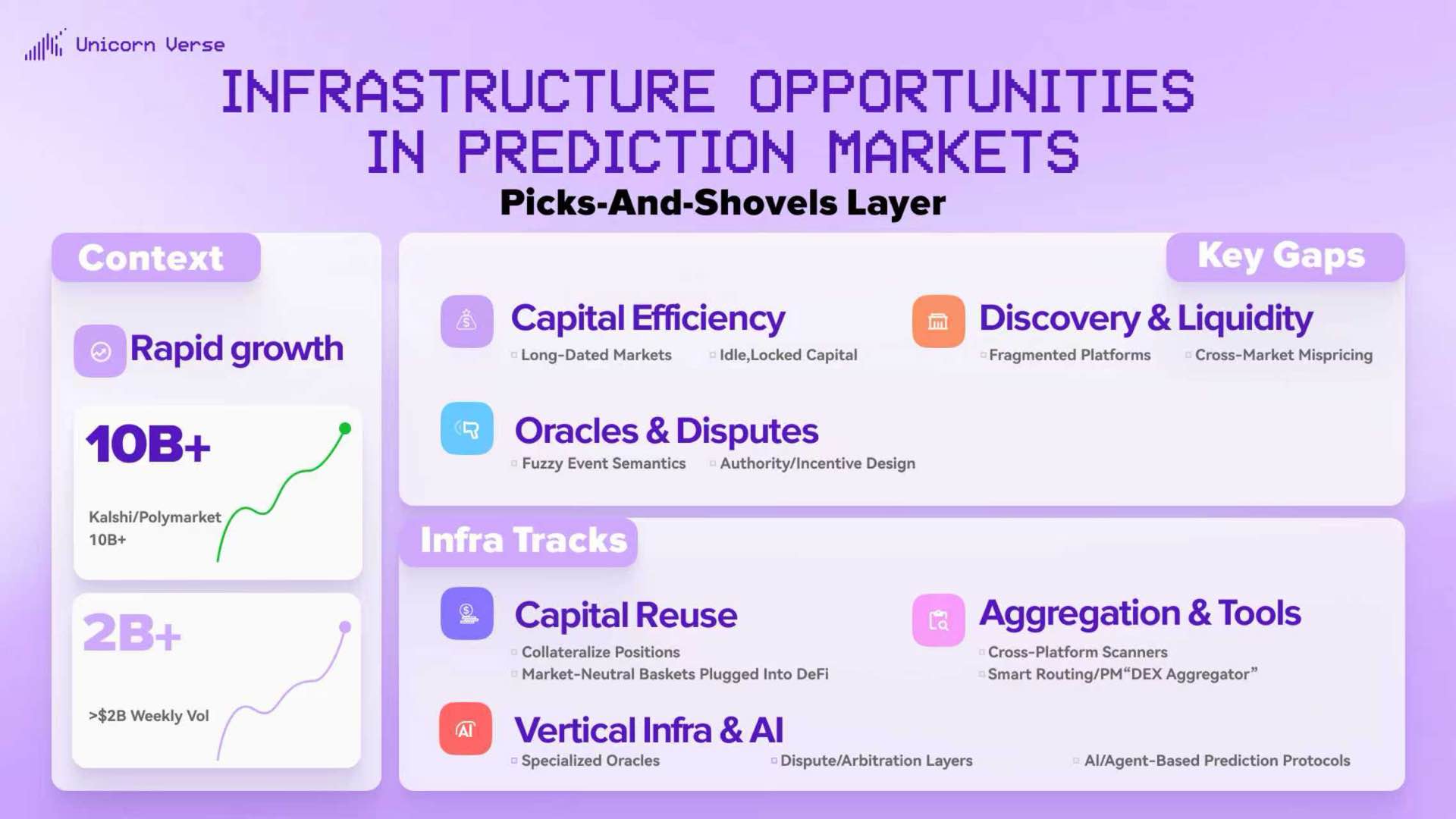
Prediction markets have expanded rapidly globally in recent years, with marked increases in trading activity and capital deployment. According to market data cited by Investopedia (Kim, 2025), mainstream prediction market platforms have exceeded $2 billion in weekly trading volume and continue growing. This indicates that as an emerging asset class, prediction markets retain substantial structural expansion potential in liquidity, user participation, and market depth.
Simultaneously, primary market interest in this sector has intensified. In the regulated event contracts space, Kalshi has reportedly been in discussions for new funding at valuations up to $12 billion, reflecting institutional capital's recognition of its regulatory moat and revenue model (The Block, 2025). In decentralized prediction markets, Polymarket has been disclosed to be seeking valuation in the $12-15 billion range, further consolidating its leadership position in crypto-native prediction markets (Bloomberg, 2025). Under the dual forces of market enthusiasm and capital inflows, prediction markets have demonstrated clear long-term growth signals.
However, this research focuses not on the competitive dynamics among trading platforms themselves, but rather directs attention beyond their trading systems: examining unmet external demands and ecosystem gaps to discuss potential opportunities for infrastructure and picks-and-shovels providers in this sector.
As prediction markets have rapidly developed within the crypto ecosystem, user base and trading volumes continue rising, yet underlying infrastructure exhibits several notable shortcomings that constrain further penetration. Based on mainstream platform trading behaviors, event structures, and actual usage patterns, core external demands can be broadly categorized into three areas:
These issues manifest both as current user pain points and as clear entry vectors for future picks-and-shovels infrastructure providers.
Capital Efficiency: Capital Lockup and Participation Incentives in Long-Duration Events
Within prediction markets, numerous events feature lengthy settlement cycles, with holding periods often significantly exceeding those of traditional derivatives. In such markets, implied probability adjustments occur infrequently, and prices may lack meaningful volatility for extended periods before settlement. Events like the 2026 World Cup champion exemplify this pattern (Polymarket, 2025)—given the event's extended timeframe and slow information update cadence, traders receive limited price signals after establishing positions, leaving capital in static occupation for prolonged periods.
From a capital utilization efficiency perspective, this means the number of event cycles in which the same capital unit can participate within a given timeframe is substantially constrained, with actual annualized returns significantly diluted. Insufficient capital efficiency also diminishes professional liquidity providers' willingness to participate in long-duration events, creating a negative feedback loop: "longer event cycles → shallower market depth → lower price volatility → worse capital utilization."
For prediction markets to accommodate larger capital scale in the future, they must provide capital reuse capabilities at the protocol or tooling layer—for instance, through cross-event collateralization, portfolio position management, interest rate markets, or dedicated capital pools—to enhance capital turnover rates and opportunity cost returns for long-duration events, transforming long-term positions from "passive capital occupation" to "further deployable assets."
Opportunity Discovery and Liquidity Aggregation: Price Discrepancies and Mismatches Across Fragmented Markets
Current prediction markets exhibit a multi-platform landscape where probability pricing for identical events often diverges significantly across platforms, yet these price discrepancies lack systematic, executable capture tools. Beyond cross-platform pricing differences, structural mismatches between Yes/No positions within individual markets can create risk-free arbitrage opportunities where "probability sums exceed or fall short of 1," exposed briefly before correction.
Additionally, as events approach expiration, prices typically converge rapidly toward certainty levels. For example, in certain interest rate events, implied probability of "whether rates will be cut" ahead of FOMC meetings has exceeded 95% (Polymarket, 2025), providing professional users near-risk-free return opportunities.
These phenomena reflect two deficiencies:
Addressing this demand, potential development directions include: prediction market aggregators (functionally analogous to DEX Aggregators), cross-market market-making and hedging bots, cross-platform smart order routing, and structured arbitrage strategy engines. Such modules could enhance price discovery efficiency, improve overall market depth, and construct clearer, scalable strategy spaces for professional liquidity providers.
Vertical Oracles: Dual Challenges of Semantic Boundaries and Adjudication Authority
Compared to traditional DeFi, which primarily processes on-chain verifiable data, prediction markets impose higher requirements on oracles, centered on accurately describing real-world events and providing credible adjudication. Consequently, vertical oracles face key challenges primarily encompassing "semantic problems" and "authority problems" (Chainlink Labs, 2023).
The semantic problem arises from inherent ambiguity in real-world events. When event descriptions lack clear boundaries, oracles must make judgments within substantial interpretive space during settlement. For instance, "Will Musk resign by year-end?" could encompass voluntary resignation, forced removal, or role adjustments. Without structured templates pre-defining trigger conditions and exclusion scenarios, settlement outcomes are prone to disputes, amplified under large position sizes. Therefore, vertical oracles must possess semantic parsing capabilities beyond data collection, reducing ambiguity through standardized event templates, clear boundary conditions, and examples.
The authority problem concerns the credibility of oracle adjudication itself. When single-market capital scale reaches tens or hundreds of millions of dollars, potential gains from manipulating settlement outcomes become extremely high, and an adjudication source lacking checks and balances directly threatens system security. Oracles must therefore design incentive-compatible economic mechanisms ensuring honest reporting yields superior expected returns versus malicious behavior, raising malfeasance costs through staking, challenge periods, dual-layer adjudication, and community arbitration mechanisms (Chainlink Labs, 2023).
Comprehensively, semantic problems determine whether events can be "clearly articulated," while authority problems determine whether results can be "broadly accepted." Together, these constitute the ceiling for prediction market oracle capabilities and point toward key directions for future infrastructure innovation.
Capital Efficiency: Transforming Prediction Positions into "Deployable Assets"
Within existing prediction markets, an intuitive problem emerges: substantial capital remains in unsettled position form within event contracts long-term, difficult to reuse before event conclusion. Several exploratory directions have emerged around this pain point.
One approach treats positions in events with high OI and active trading as collateralizable assets, establishing liquidation lines and collateralization ratios on the DeFi side, enabling users to borrow stablecoins against existing prediction positions or layer leverage atop them. This solution essentially tokenizes prediction positions and embeds them within lending models. For capital providers, this creates exposure to a diversified basket of event risks, with return profiles resembling "fixed-income-like products with pricing risk."
Another approach leverages the characteristic that Yes/No bilateral positions within the same event can construct approximately hedged positions, treating such combinations as relatively low-risk "market-neutral" assets in DeFi, granting higher collateralization ratios or relatively stable yields, enabling users to obtain additional returns without increasing directional exposure.
For such capital efficiency enhancement solutions, the genuine challenge lies not in product format itself, but in constructing reliable risk control models that appropriately quantify event risk and tail losses, securing sufficient lending liquidity on this basis. Otherwise, potential scale easily becomes constrained by risk control parameters.
Opportunity Discovery and Liquidity Integration: From "Invisible" to "One-Stop Operations"
As platform and market numbers continue increasing, prediction market users face a practical problem: targets with genuine pricing advantages or obvious mispricing are often scattered across different platforms and front-end interfaces, difficult to systematically identify in real-time. Opportunities objectively exist but remain obscured by fragmented market structures and non-unified data formats.
Addressing this demand, a cohort of tool-based products centered on "opportunity discovery" has emerged:
Overall, the key for this direction lies in: data coverage scope and depth, update frequency, and whether complete closed loops can be constructed between "discovering opportunities" and "executing trades." Deeper challenges stem from the infrastructure layer: inconsistent interface standards across platforms, relatively closed data from some centralized platforms, layered with compliance uncertainties, meaning truly comprehensive "full-stack aggregation" still faces substantial friction.
Vertical Tracks and Novel Infrastructure: Dispute Resolution and AI Prediction Protocols
Beyond capital and information-layer tools, prediction markets expose new infrastructure demands in several critical vertical segments. The most core component is dispute resolution and result adjudication.
Currently, some leading platforms (such as Polymarket) integrate UMA's Optimistic Oracle for result adjudication, delegating settlement requests for arbitrary events to UMA's oracle and dispute resolution system. For most markets with relatively clear structures and standardized rules, this mechanism already achieves relatively efficient determination and settlement (Polymarket Developer Documentation, 2025). However, for markets with larger amounts, more complex structures, or high specialization, such general-purpose mechanisms remain insufficient in response speed, professional division of labor, and responsibility allocation.
Consequently, a new development direction involves designing more "in-depth" arbitration DAOs around prediction markets: through subdividing different types of sub-courts, coupled with staking and incentive mechanisms, attracting addresses with greater experience in specific domains to participate in adjudication, forming de facto "professional juries" dedicated to handling complex events.
Another noteworthy area involves AI-integrated prediction protocols. Existing UMA-style mechanisms still primarily rely on human voting and game design, whereas enabling models or Agents to participate in prediction and settlement in more standardized ways currently lacks widely accepted universal paradigms in interface definition, data usage, and revenue distribution rules. Next-generation AI prediction protocols attempt further abstraction across these dimensions, enabling different models to participate in event prediction under unified task definitions, input/output formats, and incentive mechanisms—either directly generating probabilities and quotes or assisting with market-making or risk control.
For such vertical infrastructure, once de facto standards form at critical junctures, subsequent replacement costs rise significantly, facilitating long-term moat accumulation. Simultaneously, development pathways face dual uncertainties from regulation and technology: from identity and responsibility delineation to data source compliance and model bias control, all directly affect whether genuine scale application can be achieved.
Overall, against the backdrop of sustained expansion in prediction market trading volume and open interest, clear structural opportunity spaces remain in key infrastructure segments including capital efficiency, opportunity discovery and liquidity aggregation, and vertical oracles, providing defined opportunities for picks-and-shovels providers. The business ceiling for such projects will largely depend on the long-term growth trajectory and ecosystem maturity of the entire prediction markets sector.
Looking forward, as more compliance explorations advance and institutional and professional liquidity participation increases, infrastructure around capital reuse, cross-platform aggregation, and specialized oracles is positioned to demonstrate practical application value in the medium term. However, overall development pathways will remain influenced by regulatory environments and macro risk appetite, with timing uncertainties persisting.
It must be emphasized that this article is based solely on publicly available information for industry research and perspective synthesis, and does not constitute—nor should it be construed as—recommendations for any specific projects or any form of investment advice.
Kim, C. (2025) Prediction Markets Are Where the Action Is — And Trump Media Is Getting In On the Game. Investopedia, 28 October. Available at: https://www.investopedia.com/prediction-markets-are-where-the-action-is-and-trump-media-is-getting-in-on-the-game-11838676 (Accessed: 13 November 2025).
The Block (2025) Kalshi fielding investment offers at up to $12 billion valuation after major funding round: Bloomberg. The Block, 22 October. Available at: https://www.theblock.co/post/375778/kalshi-fielding-investment-offers-12-billion-valuation-after-major-funding-round-bloomberg (Accessed: 13 November 2025).
Bloomberg (2025) Polymarket is seeking funding at a valuation of up to $15 billion. Bloomberg, 23 October. Available at: https://www.bloomberg.com/news/articles/2025-10-23/polymarket-is-seeking-funding-at-a-valuation-of-up-to-15-billion (Accessed: 13 November 2025).
Chainlink Labs (2023) The Oracle Problem. Available at: https://chain.link/education-hub/oracle-problem
Polymarket (2024) Fed Decreases Interest Rates by 25bps After November 2024 Meeting. Available at: https://worldcoin.polymarket.com/event/fed-interest-rates-november-2024/fed-decreases-interest-rates-by-25-bps-after-november-2024-meeting
Polymarket (2025) 2026 FIFA World Cup Winner. Available at: https://polymarket.com/event/2026-fifa-world-cup-winner-595?tid=1762998773470
Polymarket Developer Documentation (2025) Resolution – UMA Optimistic Oracle integration. Polymarket Documentation. Available at: https://docs.polymarket.com/developers/resolution/UMA (Accessed: 13 November 2025).


